
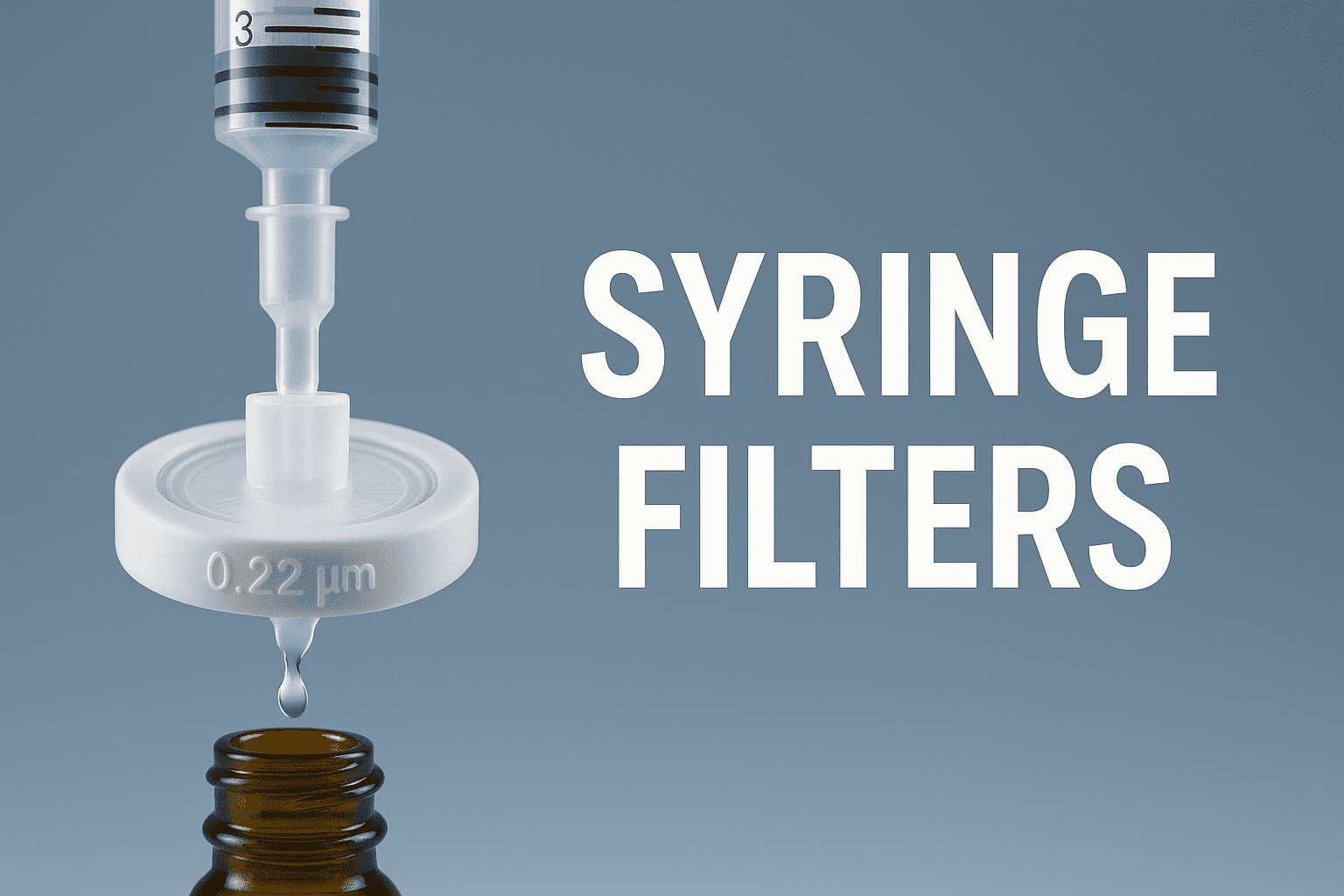
Introduction to Syringe Filters
In laboratory practices, filtration plays a vital role in ensuring accuracy, safety, and reproducibility of results. One of the simplest yet most effective tools for this task is the syringe filter. Compact and easy to use, syringe filters are essential for sample preparation, sterile filtration, and analytical testing across chemistry, biology, and pharmaceutical laboratories.
But with so many types and membrane materials available, choosing the right syringe filter can be tricky. This guide will walk you through everything you need to know—from how they work to the best practices for use.
What Are Syringe Filters?
Definition
A syringe filter is a small, single-use device attached to the end of a syringe to remove particles from a liquid sample before analysis or injection into instruments.
Basic Structure
-
Housing: Usually made of polypropylene.
-
Membrane: The actual filtration medium (varies by application).
-
Inlet/Outlet: Designed for Luer-lock or slip syringes.
How Syringe Filters Work
Syringe filters operate on a simple principle: liquid is pushed through a membrane that captures particulates while allowing solvents and dissolved molecules to pass. The pore size of the membrane determines what gets filtered.
Types of Syringe Filters
Based on Filtration Needs
-
Sterile Syringe Filters: For microbiological and cell culture applications.
-
Non-Sterile Syringe Filters: For routine sample clarification.
Based on Pore Size
-
0.22 µm filters: Used for sterilization.
-
0.45 µm filters: Common for particle removal.
-
5 µm filters and above: For pre-filtration of highly viscous samples.
Common Membrane Materials in Syringe Filters
| Membrane Material | Applications |
|---|---|
| PTFE (Polytetrafluoroethylene) | Ideal for aggressive solvents and strong acids/bases. |
| Nylon | Suitable for aqueous and organic solvents, but not strong acids. |
| PVDF (Polyvinylidene difluoride) | Low protein binding; used in biological applications. |
| PES (Polyethersulfone) | High flow rate and low protein binding—excellent for tissue culture media. |
| Glass Fiber | Used as a pre-filter for samples with high particulate matter. |
| Cellulose Acetate | Hydrophilic and low protein binding—best for aqueous solutions. |
Applications of Syringe Filters
Pharmaceutical Industry
-
Sterile filtration of drug solutions.
-
Removal of particulates before quality control tests.
Biological Research
-
Preparation of cell culture media.
-
Filtration of proteins, enzymes, and DNA samples.
Analytical Chemistry
-
Sample preparation for HPLC, GC, and spectroscopy.
-
Removal of particles that could clog instruments.
Environmental Testing
-
Filtration of water, soil, and air samples.
Advantages of Syringe Filters
-
Ease of Use: Simple attachment and operation.
-
Cost-Effective: Single-use design prevents cross-contamination.
-
High Efficiency: Removes particles quickly and effectively.
-
Versatility: Wide range of membranes and pore sizes for different applications.
Limitations of Syringe Filters
-
Not reusable (single-use only).
-
Limited volume capacity.
-
Must select correct membrane material for compatibility.
How to Choose the Right Syringe Filter
-
Determine Application: Sterile vs. non-sterile.
-
Select Pore Size: 0.22 µm for sterilization, 0.45 µm for particle removal.
-
Match Solvent Compatibility: Choose the right membrane for your solvent.
-
Consider Volume: For larger samples, pre-filtration may be required.
Best Practices for Using Syringe Filters
-
Always pre-wet hydrophilic membranes with water if using aqueous solutions.
-
Use the correct syringe type (Luer-lock recommended for safety).
-
Avoid applying excessive force-this may rupture the membrane.
-
Dispose of used filters according to lab safety protocols.
Simson Chemtech – Leading Manufacturers, Suppliers, and Exporters of Syringe Filters
Simson Chemtech is one of the trusted manufacturers, suppliers, and exporters of Syringe Filters in India, offering precision-engineered laboratory solutions designed for consistent and reliable performance.
Our Syringe Filters are crafted to meet the rigorous demands of research, clinical, and industrial laboratories - ensuring accuracy, durability, and ease of use. Built with high-quality materials, each filter is designed to provide efficient sample purification, reliable filtration, and compatibility with various solvents and solutions.
Backed by ISO-certified standards and global export capabilities, Simson Chemtech continues to support laboratories worldwide with dependable scientific instruments and accessories.
Maintenance and Storage
Syringe filters are single-use and do not require cleaning. Store them in a dry, dust-free environment, away from direct sunlight, to maintain integrity.
Conclusion
Syringe filters may be small, but they are critical in ensuring the quality, reliability, and reproducibility of laboratory results. With the right selection of pore size and membrane material, you can achieve accurate filtration for applications ranging from pharmaceuticals to environmental science. Investing in high-quality filters saves time, prevents contamination, and protects valuable equipment.
You can buy Syringe Filters from trusted manufacturers, suppliers, and exporters in India. For premium-quality Syringe Filters, Simson Chemtech is a leading manufacturer and supplier in India.
FAQs About Syringe Filters
Q1. Can syringe filters be reused?
No, they are designed for single-use to prevent contamination.
Q2. Which pore size should I choose?
For sterilization, use 0.22 µm; for particle removal, 0.45 µm is sufficient.
Q3. Can I use syringe filters for protein samples?
Yes, but select low-protein binding membranes like PVDF or PES.
Q4. What’s the maximum volume I can filter?
Typically 5–200 mL, depending on filter size and viscosity of the solution.
Q5. Can syringe filters handle organic solvents?
Yes, but use chemically resistant membranes like PTFE or Nylon.
Q6. Are syringe filters compatible with HPLC?
Yes, pre-filtration ensures instrument safety and accuracy.